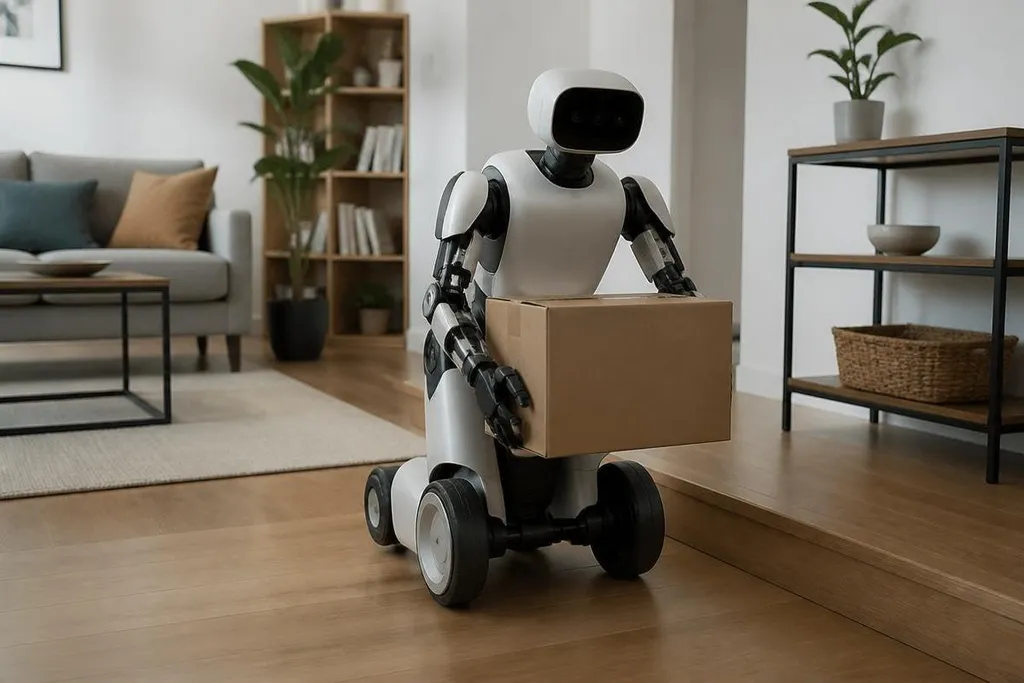
A chatbot can answer a request in seconds. A robot has to turn that answer into safe movement while its cameras, motors, battery, and surroundings keep changing. Giving a language model a body adds useful skills, but it also adds problems that text alone can hide.
Quick read
- A language model can plan a task, but a separate control system must move the robot.
- Cameras and other sensors give the robot information about its surroundings.
- Safety checks must block bad commands before motors receive them.
Text does not move a motor
A chatbot works with words. It predicts a useful response from the text it receives, then produces more text. Movement needs a different chain: sensors collect information, software builds a picture of the scene, a planner chooses an action, and a controller sends commands to the motors.
That chain matters because a sentence such as “pick up the cup” leaves out many details. The robot must find the cup, estimate its shape and position, choose a safe grip, move its arm around nearby objects, and check whether the hand actually holds it.
A language model can help break the task into smaller steps. It might turn “make tea” into actions such as finding a kettle, filling it, placing it on a base, and waiting for the water. The robot still needs other software to check each step against what its sensors see.
The language model is closer to a task planner than a direct motor controller. Sending its raw output straight to the joints would be unsafe.
The body adds useful information
The physical body gives the software access to cameras, microphones, force sensors, wheels, legs, or arms. These inputs let the system respond to objects and people instead of working from text alone.
That connection is often called embodied AI. The word “embodied” means the software can act through a physical machine and receive new information from that machine. If a gripper slips, a force sensor can report the change. If a box blocks a route, a camera can show the obstacle.
The loop has to run again and again. The robot senses the scene, chooses the next action, moves, checks the result, and adjusts. A delay that feels minor in a chat can matter when an arm is moving near a person or carrying a glass object.
This is where software layers matter. A language model may choose the broad action, while motion planning handles the arm path and a low-level controller manages motor speed, torque, and position. Each layer has a narrower job, which makes faults easier to find.
Words still create bad actions
Language models can produce answers that sound right but contain false details. In a robot, that error can become a wrong object, a missed step, or movement toward the wrong place.
The robot therefore needs checks outside the language model. These can compare a planned action with sensor data, limit the arm’s speed, restrict movement near people, and stop the system when the result differs from the plan.
A human may also approve selected actions. That slows the task, but it gives an operator a chance to reject a command before the robot moves. The right level of human control depends on the task, the robot’s reach, and the cost of an error.
The useful test starts when language has to move a body. Robot24.com's reporting on embodied AI can tie that step to named robots and measured tasks before the next section asks where the idea works first.
Where the idea works first
Chatbot-based robot control fits tasks with clear goals and frequent feedback. A research team may ask a robot to sort known objects, find a tool, or follow a spoken sequence in a controlled room.
Open-ended work is harder. Homes contain changing layouts, loose cables, reflective surfaces, small objects, and people who do not move on a fixed path. Handling one room well does not prove the robot will work when the table, lighting, or object position changes.
Training also matters. A robot needs examples of actions, failures, recovery steps, and safe limits. Simulated practice can reduce wear on hardware, but a simulation may miss soft materials, slippery surfaces, sensor noise, or a motor that behaves differently under load.
I’d trust a chatbot-connected robot first with tasks that have clear boundaries and an easy stop, not with free movement around a busy workplace.
A practical buying and testing checklist
Before you judge a robot with a chatbot interface, check:
- Task limits: Which actions can the system run without a person approving each step?
- Sensor input: Can it identify object position, contact, and failure during the task?
- Motor control: Does a separate controller limit speed, force, and joint movement?
- Recovery: What does the robot do after a dropped object, blocked route, or failed grip?
- Operator stop: Can a nearby person stop motion quickly with a physical control?
- Test record: Does the maker show repeated runs, failed attempts, and conditions outside a staged demo?
These checks tell you where the language model ends and the robot system begins. That boundary will decide whether the machine can repeat a task safely, rather than whether it can describe the task well.
The next step is better coordination between language, vision, motion planning, and control. Until those parts work together across changing rooms and repeated tasks, a chatbot with a body remains a promising interface attached to a demanding robot problem.